
Reader Solutions Reviewed: Sliding Window
Challenge: Longest Substring Without Repeating Characters


Problem recap
Interview question
Given a string s, return the length of the longest substring without repeating characters.
Examples:
s = "abcabcbb"→3(answer is"abc")s = "bbbbb"→1(answer is"b")s = "pwwkew"→3(answer is"wke")
Constraints typically look like:
1 <= s.length <= 5 * 10^4Characters are usually standard ASCII; LeetCode’s version allows spaces, punctuation, etc.
Baseline idea: sliding window over a string
Naive thinking says: enumerate all substrings and check them one by one. That’s O(n^2) substrings and O(n) to check each, which is dead on arrival.
Instead, this problem is a textbook variable-size sliding window:
Maintain a window
[left, right]that always has no duplicates.Expand
rightone character at a time.If the new character makes the window invalid (duplicate), move
leftforward until the window is valid again.Track the best window length seen so far.
All of the implementations below share this same mental model; they only differ in how they detect and fix duplicates (array vs. hash map vs. set).
Approach 1: Hash map frequency (clean, general-purpose)
This is the version I’d expect a strong candidate to reach first in an interview: use a hash map from character → count to track what’s inside the window.
Python (hash map)
def length_of_longest_substring(s: str) -> int:
    freq = {}          # char -> count in current window
    left = 0
    best = 0

    for right, ch in enumerate(s):
        freq[ch] = freq.get(ch, 0) + 1

        # If ch is now duplicated, shrink from the left
        while freq[ch] > 1:
            left_ch = s[left]
            freq[left_ch] -= 1
            if freq[left_ch] == 0:
                del freq[left_ch]
            left += 1

        best = max(best, right - left + 1)

    return best
Java (hash map)
public int lengthOfLongestSubstring(String s) {
    Map<Character, Integer> freq = new HashMap<>();
    int left = 0;
    int best = 0;

    for (int right = 0; right < s.length(); right++) {
        char c = s.charAt(right);
        freq.put(c, freq.getOrDefault(c, 0) + 1);

        while (freq.get(c) > 1) {
            char leftChar = s.charAt(left);
            freq.put(leftChar, freq.get(leftChar) - 1);
            if (freq.get(leftChar) == 0) {
                freq.remove(leftChar);
            }
            left++;
        }

        best = Math.max(best, right - left + 1);
    }

    return best;
}
C# (dictionary)
public int LengthOfLongestSubstring(string s) {
    var freq = new Dictionary<char, int>();
    int left = 0;
    int best = 0;

    for (int right = 0; right < s.Length; right++) {
        char c = s[right];
        freq[c] = freq.GetValueOrDefault(c) + 1;

        while (freq[c] > 1) {
            char leftChar = s[left];
            freq[leftChar]--;
            if (freq[leftChar] == 0) {
                freq.Remove(leftChar);
            }
            left++;
        }

        best = Math.Max(best, right - left + 1);
    }

    return best;
}
Complexity
Time: O(n), each character enters and leaves the window at most once.
Space: O(k) where k is the number of distinct characters in the window, k≤128 for ASCII.
When this shines
You want a generic sliding window template that adapts to “at most K occurrences”, “at most K distinct characters”, etc.
You’re not sure about the character set (could be Unicode, emojis, etc.).
Approach 2: Hash set + left pointer (simpler state)
If all you care about is “no duplicates at all”, you don’t actually need counts—just membership. A hash set stores the characters in the current window.
Python (set)
def length_of_longest_substring_set(s: str) -> int:
    seen = set()
    left = 0
    best = 0

    for right, ch in enumerate(s):
        # If ch is already in the window, move left until it's gone
        while ch in seen:
            seen.remove(s[left])
            left += 1

        seen.add(ch)
        best = max(best, right - left + 1)

    return best
Java (HashSet)
public int lengthOfLongestSubstringSet(String s) {
    Set<Character> seen = new HashSet<>();
    int left = 0;
    int best = 0;

    for (int right = 0; right < s.length(); right++) {
        char c = s.charAt(right);

        while (seen.contains(c)) {
            seen.remove(s.charAt(left));
            left++;
        }

        seen.add(c);
        best = Math.max(best, right - left + 1);
    }

    return best;
}
C# (HashSet)
public int LengthOfLongestSubstringSet(string s) {
    var seen = new HashSet<char>();
    int left = 0;
    int best = 0;

    for (int right = 0; right < s.Length; right++) {
        char c = s[right];

        while (seen.Contains(c)) {
            seen.Remove(s[left]);
            left++;
        }

        seen.Add(c);
        best = Math.Max(best, right - left + 1);
    }

    return best;
}
Complexity
Time: O(n) average with set operations expected O(1).
Space: O(k) distinct characters, like the map approach.
When this shines
You want the simplest readable solution for this specific problem.
You don’t need frequency counts or more complex constraints.
Approach 3: Character index array (true O(1) space for ASCII)
In many LeetCode-style constraints, the input is restricted to ASCII. When that’s true, you can trade generality for a flat array indexed by character code, which removes hashing overhead and pins space to a constant.
Two common patterns:
Last-seen index:
lastIndex[c]= last index wherecappeared, or-1if never.Frequency array: Like the map-based sliding window, but with an array of length 128.
I like the last-seen-index version because it eliminates the inner while loop and keeps the window valid by jumping left forward in one step.
Python (last-seen index, ASCII)
def length_of_longest_substring_ascii(s: str) -> int:
    # 128 for standard ASCII; use 256 or 256k if needed
    last_index = [-1] * 128

    left = 0
    best = 0

    for right, ch in enumerate(s):
        code = ord(ch)

        # If we've seen this char inside the current window, move left
        if last_index[code] >= left:
            left = last_index[code] + 1

        last_index[code] = right
        best = max(best, right - left + 1)

    return best
Java (last-seen index, ASCII)
public int lengthOfLongestSubstringAscii(String s) {
    int[] lastIndex = new int[128];
    Arrays.fill(lastIndex, -1);

    int left = 0;
    int best = 0;

    for (int right = 0; right < s.length(); right++) {
        char c = s.charAt(right);
        int code = (int) c;

        if (lastIndex[code] >= left) {
            left = lastIndex[code] + 1;
        }

        lastIndex[code] = right;
        best = Math.max(best, right - left + 1);
    }

    return best;
}
C# (last-seen index, ASCII)
public int LengthOfLongestSubstringAscii(string s) {
    int[] lastIndex = new int[128];
    Array.Fill(lastIndex, -1);

    int left = 0;
    int best = 0;

    for (int right = 0; right < s.Length; right++) {
        char c = s[right];
        int code = (int)c;

        if (lastIndex[code] >= left) {
            left = lastIndex[code] + 1;
        }

        lastIndex[code] = right;
        best = Math.Max(best, right - left + 1);
    }

    return best;
}
Complexity
Time: O(n).
Space:
Array length is fixed (e.g., 128), so strictly O(1) with respect to input size.
When this shines
You’re in a tight performance setting (competitive programming, very large number of test cases, strict limits).
The interviewer has explicitly restricted the alphabet to ASCII or to a small known set.
Comparison: map vs. set vs. array
Here’s how these approaches stack up from an interviewer’s point of view.
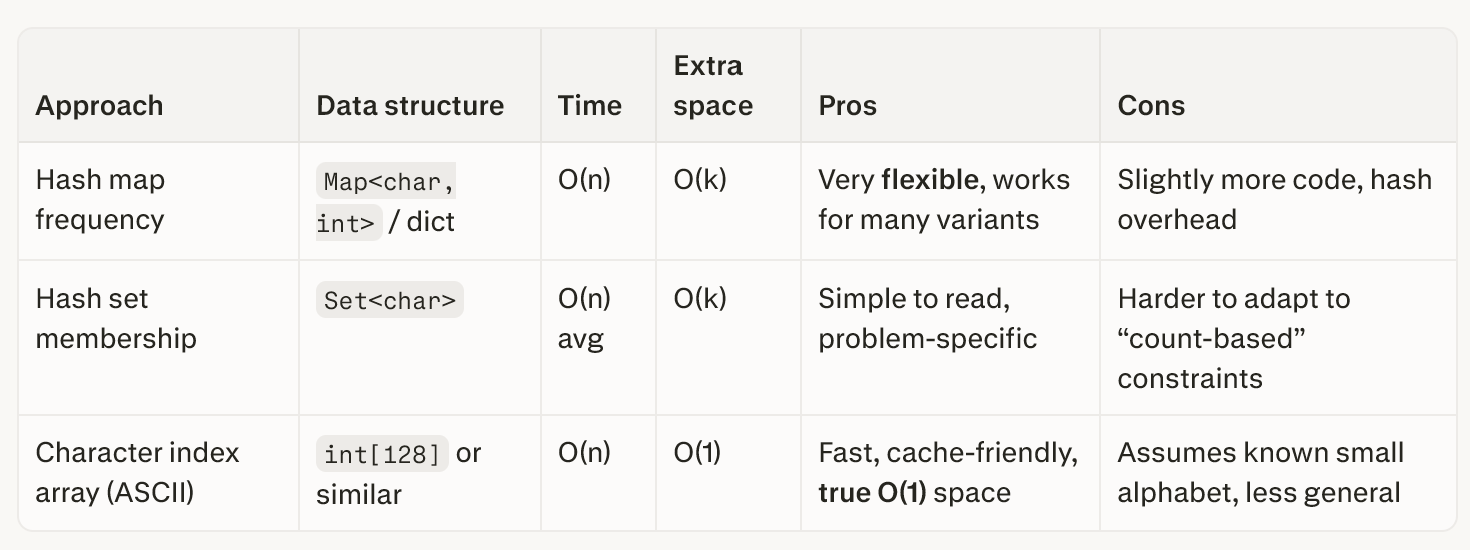
Here k is the number of distinct characters, which is bounded by 128 for ASCII but may be larger in Unicode scenarios.
When does “O(1) space” actually matter here?
On paper, all three are “O(n) time, O(1)/O(k) space”, and it’s tempting to optimize preemptively. In actual interviews, I’d bucket it like this:takeuforward+3
Most interviews
The map or set solution is completely fine.
The real evaluation is about:
Recognizing the sliding window pattern.
Managing indices and invariants cleanly.
Explaining why the algorithm is O(n) (each char enters/leaves the window at most once).
Performance-obsessed interviewers / follow-up questions
They may ask: “Can you do it in O(1) space?”
That’s your cue to say:
“If we can assume the input is ASCII, we can replace the map with a fixed-size array indexed by character code, which makes the additional space independent of
n.”
Dropping that shows you can connect constraints to implementation choices.
When not to over-optimize
If your first attempt with the array is buggy or hard to explain, it’s worse than a clean map-based solution.
Most production environments don’t care about the tiny constant-factor improvement here unless you’re processing giant logs in a tight loop.
A good rule you can even say out loud: “I’ll start with the hash map version for clarity, and if we need to squeeze constants or space, we can switch to a fixed-size array given ASCII constraints.”
Want to see how interviewers really grade this problem?
The paid section breaks down why two almost-identical solutions get very different outcomes in real interviews: what strong candidates say about their window invariant, complexity, and follow-ups that upgrades this into a genuine positive signal.
➡️ Unlock the interviewer’s rubric for this problem
